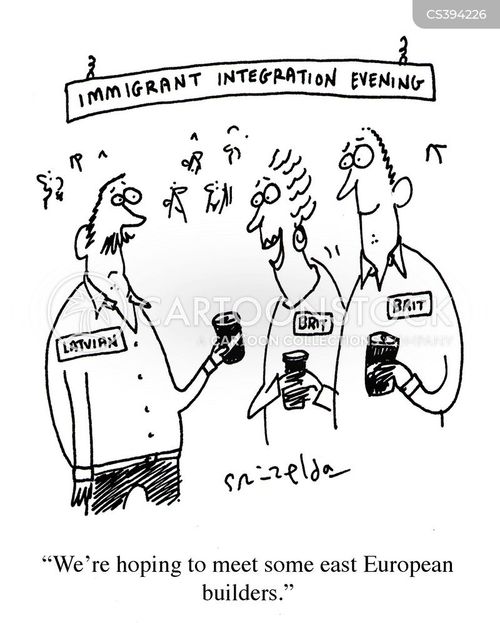
Ah, integration in the UK. The central topic for many politicians and for the Home Office. One of the most controversial subjects when people, regardless of their background, start talking about immigrants. The topic that helps blame all problems the nation faces on immigrants.
In software development, we have a notion of ‘definition of done’. This means that, if you want a new software feature to work the way you intended it to be, you need to be as precise and detailed as possible when describing what you expect, how exactly it is going to work and what should be the outcome of said feature.
The problem with the topic of integration (or many other political topics, for that matter) is that politicians typically fail to provide that ‘definition of done’. The Reform party might have a point about how important it is for foreigners to integrate into the UK society. It’s not an unreasonable sentiment – but what does integration actually mean? When can you mark this task as ‘done’?

Last year’s Home Office’s white paper on restoring control over immigration states that integration in the UK must be a prerequisite for settling in the UK permanently, and the command of English, the knowledge of British history, traditions, laws etc., and paying taxes above a particular threshold are among the things that define integration.
The white paper from the Home Office states integration is essential – how do you really measure it? (it’s like when my company is trying to quantify the level of relationships with our clients)
Putting my own emotions on the matter aside, I still can’t help but wonder if those things are a good enough ‘definition of done’. If I were to remain in Belarus and it had an influx of immigrants, what would I expect them to do to earn their right to settle in my country? What makes someone truly British (truly Belarusian, etc.)? What sort of threshold in your own mind you should set for yourself if you want to integrate into the British society?
So many questions, barely any straightforward answers. I did, however, try my best to think of criteria I apply to myself. The jury is still out on whether that would match the Labour party’s list, but here we go:
- Speaking the language
That’s probably the only thing where I am absolutely ruthless (probably more ruthless than Mr Farage). If you come to live in the UK, you MUST speak English. And you must become fluent in it if you want to qualify for a permanent settlement. Despite the fact a major share of communication between human beings is non-verbal, language is still our main tool for talking to each other. If you can’t speak fluently, you will get misunderstood easily, it’s very easy to offend (or at least to annoy) others unintentionally, not to mention that it prevents you from building relationships with people outside of your native language’s bubble – and more often than not, from getting a good job.
The B2 level is actually quite a low threshold. With the right learning methodology, the right commitment and amount of effort, anyone can learn almost any European language to the B2 level in a year – especially if they get to hear that language on a daily basis. Happy to bet on that.
- Understanding local humour
We’re not talking about ‘niche’ jokes or internal memes that only a handful of people can get. It is, however, essential to learn to understand the word play in your new language and to be in a position to understand at least most jokes in the TV shows popular in your new home country.
Humour is a universal social glue. When you and your friends or your partner can laugh at the same things, it inevitably boosts the relationship and improves the connection. This is because we get the subconscious feeling that the other person is on the same wavelength with us – and, hence, can be trusted.
Needless to say, none of this is possible without properly mastering the language.
- Reading the room
I know this is tricky and absolutely unmeasurable. Yet, when you can read the room, understand what is acceptable to say and what isn’t, it is a good manifestation of how well you now understand societal norms, either consciously or intuitively.
I had to collect a parcel from a corner shop a few months ago. The gentlemen working at that shop was understandably struggling with my name (‘Katsiaryna’ is quite a mouthful even for me) and complained ‘oh, it’s a very long name!’ The integrated me had a very British response: ‘Yeah, sorry about that!’ An old me would have probably gone for something racist and Eastern European-style aggressive like ‘That’s rich coming from you, what is your name?’
- Understanding the cultural differences – and knowing how to bridge that gap
When we move to a new country, inevitably, we bring some luggage with us, including our beliefs, norms, prejudices and expectations. Or culture, to be more succinct. Learning how things are run in a new culture is not easy. What is even more complicated is closing that gap between your own culture and your new one. The absolute summit in that cultural quest is knowing when to prioritise local norms and let your own background take a back seat – and when to let your culture roam free.
When I first got invited to a traditionally British household, I brought over a bottle of Prosecco, a bunch of flowers and a box of chocolates. Showing up at someone’s house empty-handed is akin to a crime in my native country. What took me aback is that the hostess didn’t put that bottle of Prosecco or the chocolates on the table for the guests and, instead, kept them for herself. There were plenty of drinks and food (including a pudding) on that table, yet, it was shocking for me to learn that, unlike in the Eastern European culture, where you have to put the food and drinks from the guests onto the table, that’s not exactly the case in a British household. And while I will put the presents from my guests on the table for everyone to share and enjoy, I no longer expect anything like that from anyone in the UK.
There is one thing from my Belarusian background that I will NEVER drop. Regardless of how British I get to become. And that thing is:
I
ALWAYS
TAKE
MY
LITTER
TO
THE
RUBBISH
BIN.
Seriously, people, it’s a relatively small island, would it kill you to look after your own country?! It’s not that hard, and putting your trash into rubbish bins is the least you can do!
How to measure the unmeasurable?
In the software development world, it’s sometimes tricky to word that ‘definition of done’. In the real world, with real human beings, subjective views, varying circumstances and exceptions that prove the rule, setting a one-size-fits-all approach for everyone is even harder.
If you stick around with other expats from your own country, does it necessarily mean you are not integrating in your new country? Or does it mean that they understand your specific challenges that people from other countries have no clue about? And you can’t really focus on watching local TV shows and learning to understand your new country’s humour when you are desperate to address the basics. Put your oxygen mask on first, then deal with everything else.
If you are wearing traditional clothes from your native country, does that mean that you fail at integration and are trying to show that off? Or does it symbolise the multiculturalism of your new home country and helps you feel more like yourself, which, in turn, is what helps you meet new people, practise the language and grasp those tiny cultural nuances?
If you refuse to adapt some of the local practices that seem to be normal in that country but get frowned upon in your own country (well, hello to you, people who fly tip!), does it mean you are not integrating? Or does it mean that you just want to bring something new to the nation that will, step by step, one person and one day at a time, make it even better?
There’s no straightforward way to becoming a new Brit – or a new American/ Spaniard/ Belarusian, etc., for that matter. All we can do is make an effort – every single day, big or small – and have the best intention to our new country. Sometimes this is enough.
What does integration mean to you? If you are an immigrant yourself, at what stage did you feel like you started to belong in your new homeland? Share your thoughts in the comments!





Leave a Reply